


> Home > >

Giuditta Siena
.jpeg)
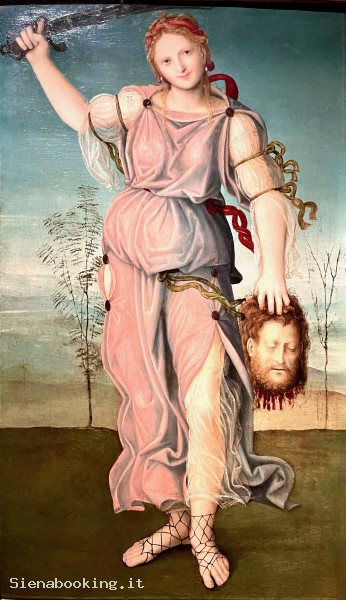
Artist: Domenico Beccafumi
Year: 1506-1507
Current location: Collezione Chigi Saracini
DESCRIPTIVE INFORMATION
The first figure in a series of three, Judith is depicted holding Holofernes' bloody head by the hair.
In the Middle Ages, Judith already symbolized fidelity, chastity, and continence, which triumphed over the pride and lust of the Babylonians. To understand the origins of this symbol, we must return to the biblical narrative. In the Old Testament, the Book of Judith emphasizes the heroine's exemplary piety, but also her chastity as a young widow who remained four nights in the general's camp without losing her purity. In the eighteenth year of Nebuchadnezzar II's reign, Judea was conquered by Holofernes, acting on behalf of the king, who desired to annex the surrounding lands to his empire and be worshipped there as the one God.
Holofernes and his men quickly besieged Bethulia and seized the spring that supplied the city with water. The ploy was intended to force the population to surrender to the invaders. Exhausted and resigned, the inhabitants gathered around Uzziah, the city's prince; they decided to pray to their Lord God for five days, after which they would surrender to the Assyrians if no help came.
It is in this context that Judith, a beautiful and wise young woman, deeply devout since her widowhood three years earlier, intervenes. She meets Uzziah and some of the city's former leaders, sharing with them a plan, without revealing its nature, to save her people. Dressed in her finest robes, Judith reaches Holofernes's camp; she explains to the general her divinely inspired plan to deliver the Jews into his hands.
Convinced by the wisdom of the young woman's words, and even more captivated by her beauty, Holofernes grants her complete freedom, even allowing her to leave the camp each evening to worship her God. On the fourth evening, Holofernes hosts a grand banquet, to which his officers and Judith, who has won his trust, are invited. After the meal, the heroine is left alone in the tent with Holofernes slumped on the bed, drunk. This is the ideal moment to put her plan into action; she silently calls upon God, then, putting this plan into action, cuts off Holofernes's head before carrying it off in her flight.
Giuditta.jpeg)